16 min read

Most brands are still stuck in one-off influencer deals, paying premium prices for a single shot and hoping it lands. Meanwhile, more progressive brands are using creators on retainer to get up to 25.8 million views a month from accounts with a median of just 92 followers.
In a recent Creally webinar, Tatiana Shestakova, Head of Creative Production at a health and fitness brand, and Creally CEO Nikita Zatsepin broke down how to stop overpaying for one-off deals and build your own creator network that consistently delivers content, views and installs.
Here's what you'll learn in this article.
- How the creators on retainer model works and why it costs less than classic integrations
- Real cases with tens of millions of views from accounts with only a few hundred followers
- A step-by-step plan to launch a creator program from scratch
- The metrics and benchmarks that tell you when to keep or let go of a creator
- How to measure organic impact and scale from 10 to 100 creators without growing your team
You can watch the full webinar on YouTube and find more definitions in our Influencer Marketing Glossary.
Creators on retainer - creators who get a fixed monthly fee to produce a set volume of content for a brand.
Why One-Off Influencer Deals Are Burning Your Budget
Tatiana has worked in influencer marketing since 2016, when apps spent $50K or more a month on celebrity integrations. Since then, she has advised brands with monthly budgets from $5K to $70K.
Her advice is simple. If your strategy still relies on one-off integrations, you're overpaying for results you can neither predict nor repeat.
Here is why this model struggles today.
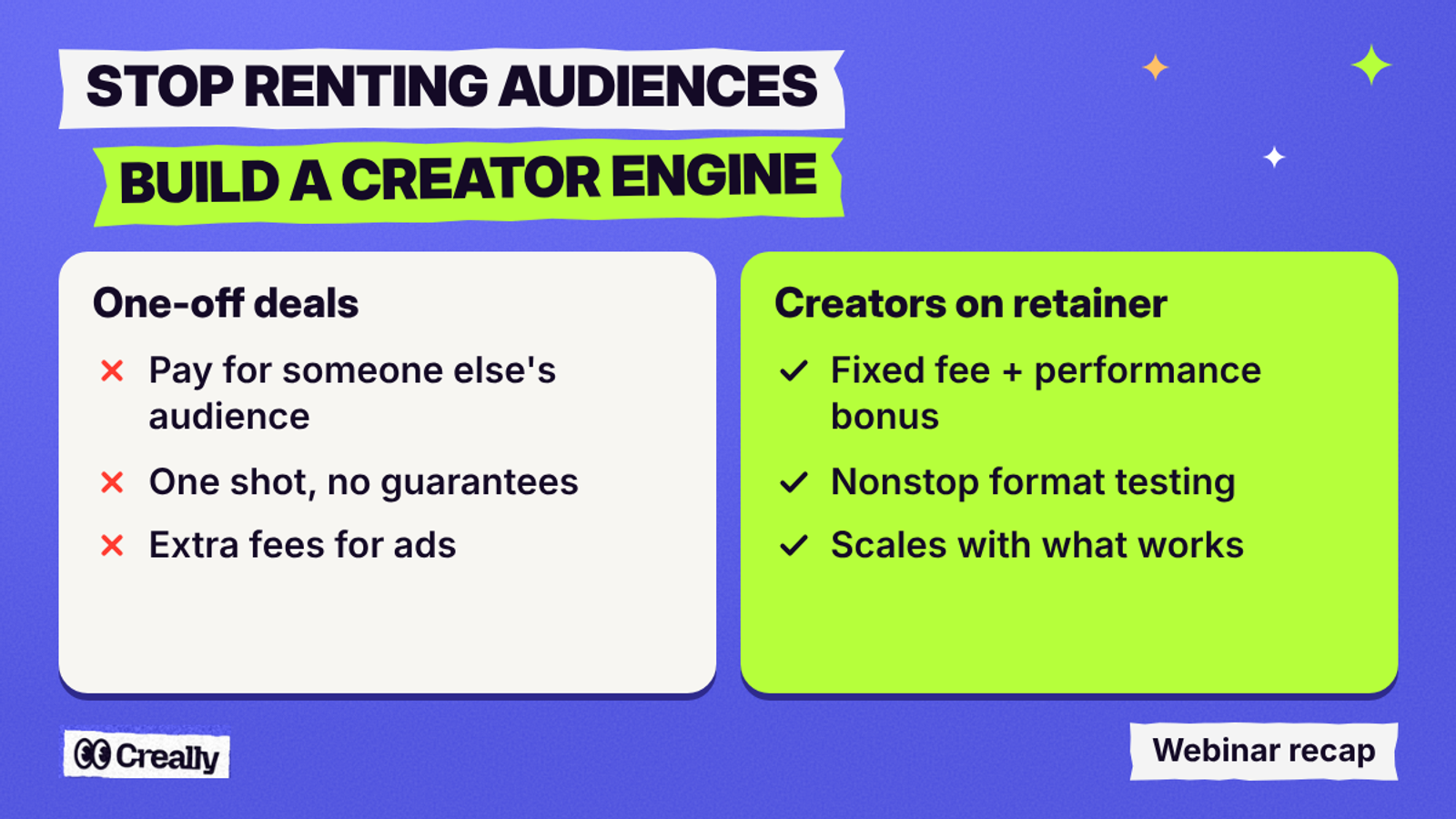
- You mostly pay for access to an existing audience, not for content with viral potential
- You get one shot, little room to experiment and no guarantees
- Using the video in paid ads usually means extra usage fees
- Sponsored posts often get fewer views than the creator's regular content
- Audiences trust influencers less, especially when a creator promotes a competitor one day and your brand the next, unless you pay extra for exclusivity
CPM-based pricing doesn't remove the risk either. Creators calculate the rate from their median views. If you expect a $5 to $10 CPM and the video underperforms, you can easily end up paying $30 to $50 per 1,000 views.
Usage rights - permission for a brand to reuse a creator's content, for example in paid ads.
Exclusivity - a contract clause that bans a creator from working with competitors for a set period.
CPM (cost per mille) - the price paid for 1,000 views or impressions.
What Is the Creators on Retainer Model and Why Smart Brands Are Switching
Algorithms have leveled the playing field. On TikTok, Reels and Shorts, good content can reach millions of people no matter who posts it. That's why smart brands are moving budgets from a handful of celebrities to an army of small creators.
With a retainer model, you stop renting someone's audience and start building your own external creative production team. The healthiest setup is a small fixed fee for producing content plus performance-based bonuses on top.
In practice, you get a three-in-one channel.
- Organic reach on the creators' own accounts
- A steady stream of creatives for paid ads
- Constant testing of hooks, angles and formats without paying ad platforms for every test
The biggest advantages are consistency and a focus on business goals rather than vanity metrics like views and likes.
Performance-based bonus - an extra payment when a video hits agreed results, such as views or sales.
How Tiny Creator Accounts Generate Tens of Millions of Views
These cases show how far small accounts can go once you find the right format.
- Cantina AI, an AI social app, runs about 122 creator accounts with a median of roughly 92 followers. It generated 25.8 million views from 1,545 videos in just 30 days (see the case at 12:00 in the webinar)
- OpusClip, an AI video editing tool, built a network of 69 creator accounts with repeatable formats around AI side hustles and faceless YouTube channels. It earned 31.4 million organic views from 3,903 videos in three months and reuses the videos in paid campaigns (12:44)
- Sona, an astrology app, runs 32 creator accounts that all post one format, a one-minute selfie video about zodiac signs and relationships. Creators present Sona as "their" app, so the promotion feels native. The format brought in nearly 41 million views from 1,935 videos (18:01)
- At Lensa AI, where Tatiana previously led creative production, a single Magic Avatars video grew to 184 million views (13:47)
The pattern is always the same. Test many videos, find the winning format and scale it across many creators.
Volume isn't always required, though. A solo founder can reach $10K to $20K in monthly recurring revenue with just three creators and one strong format (18:33). That's a great result for a solopreneur, while a larger company will need more scale.
Content format - a repeatable video structure that many creators can recreate.
Millions of Views, Zero Revenue? How to Avoid the CPM Trap
Views are not revenue. A common trap is buying tens of millions of CPM-based views that end up producing just a handful of installs.
Optimize for business metrics from day one and think about the whole funnel, not only the hook. Before launching, check these points.
- Does the video have a clear CTA?
- How easy is it to find the product in the App Store, Google Play or search?
- Are you covering branded keywords, for example in Apple Search Ads?
- Can a viewer get from the video to the product without friction?
Hook - the first one to three seconds of a video that stop viewers from scrolling.
CTA (call to action) - a prompt telling viewers what to do next, such as "download the app".
Branded keywords - search queries that include your brand or product name.
Is Your Product Ready for a Creator Army?
The model works best for consumer apps and products in beauty, fashion, wellness and fitness. In short, it fits anything that's easy to demonstrate, visually appealing and full of angles for creators to play with.
It's a harder fit for niche B2B products with a tiny audience, a six-month sales cycle or an offer that can't be explained in 30 seconds. Influencer marketing can still work in B2B, but there, a few industry experts will deliver more than a big UGC network.
Niche doesn't automatically mean no-go. Peech, a text-to-speech app and Creally client, built creator networks in several countries and found its audience of people who prefer listening to reading. It has worked with one of its creators continuously since August 2025 (23:17).
Creators won't fix a product that isn't ready to scale. A viral feature, a clever onboarding flow or a recognizable interface can become a hook.
But if retention is poor, the funnel is broken or the unit economics don't work, creators will simply bring more people into a broken experience.
Before launching a program, ask yourself two questions.
- Is my product naturally interesting to talk about?
- Can I turn that attention into business results?
If both answers are yes, start. If not, fix the product first.
Retention - the share of users who keep using a product over time.
Unit economics - the revenue from one customer compared with the cost of acquiring and serving them.
How to Launch a Creator Program From Scratch in 6 Steps
Treat creator marketing exactly like performance creative production. Here's Tatiana's launch plan, using a new stretching app as an example (24:49).
- Build a pool of hypotheses around audiences, hooks, creative angles, pain points and creator personas
- Research current content trends
- Turn the research into simple dos and don'ts and suggested formats for the first launch
- Find creators for the first batch using a creator discovery platform or a custom AI agent
- Launch, analyze the results and document every learning
- Turn those learnings into a creator playbook
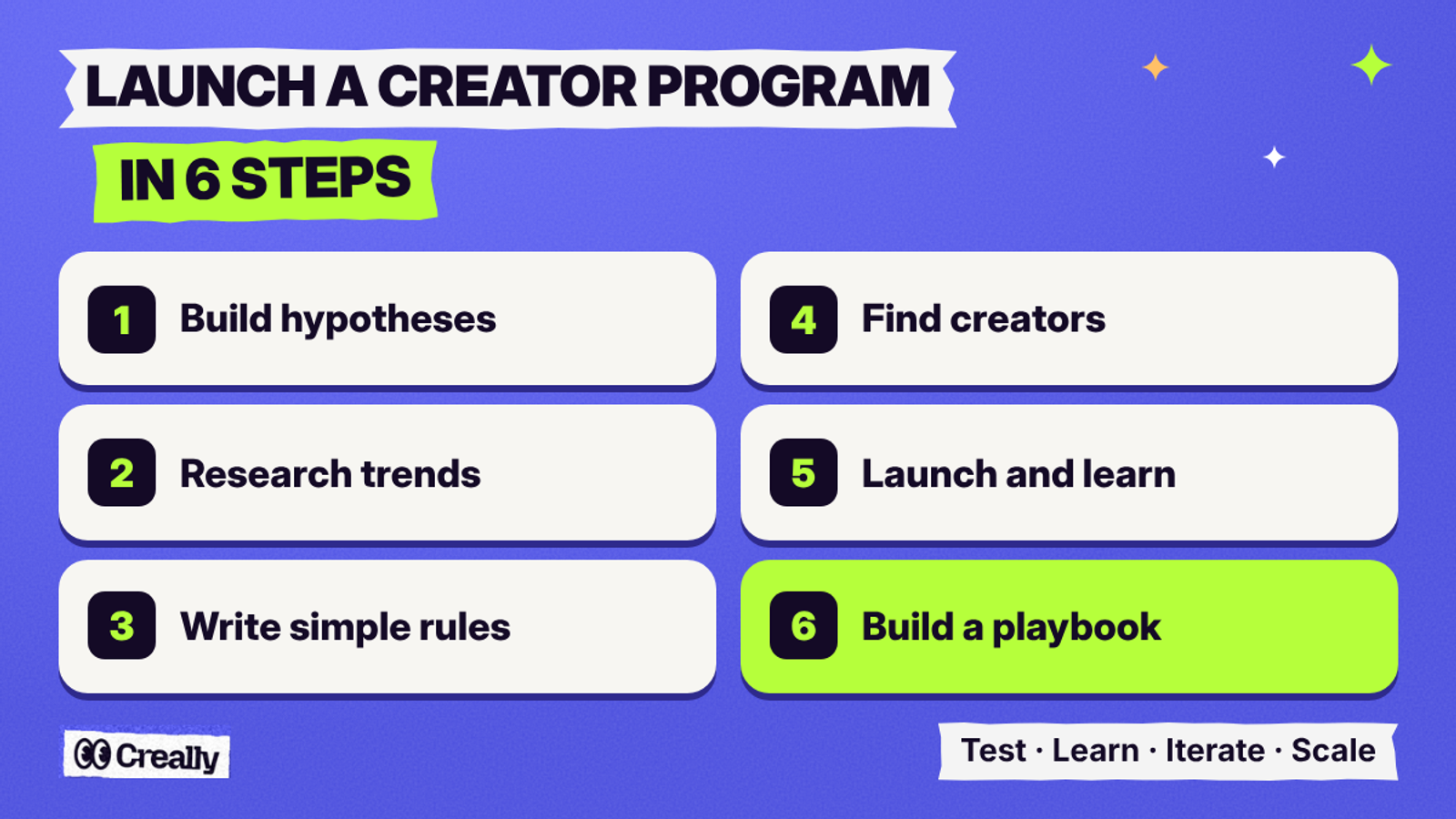
Use the playbook to onboard new creators, scale your strongest performers and replace those who consistently underperform.
Test different creator personas from the very first batch. For a fitness app, that might mean stay-at-home moms, busy "girl bosses" and single people of different genders. Then double down on the personas that perform and look for similar creators.
For the content mix, start with five to ten concepts and three hook variations for each. Over time, keep about 80% of production focused on scaling proven formats and 20% on completely new experiments. Otherwise, you end up building a factory for yesterday's trends.
The testing phase never ends. Test, learn, iterate, scale and repeat. The goal isn't to produce more videos but to discover more winners and scale them.
Creative angle - the main idea a video uses to present the product, such as saving time or money.
Creator persona - the type of person on camera, defined by age, lifestyle, look and tone.
Creator playbook - an internal guide with winning formats, hooks, messaging and failed experiments.
Keep or Cut? The Metrics That Tell You Which Creators Are Worth It
A head of growth who built a pool of 400+ creators with over a billion views shared a blunt lesson with Nikita. A big part of running such a program is knowing when to let go, which takes strict qualification criteria and fast decisions.
Track two groups of metrics.
- Creator performance covers hook rate, average watch time, engagement rate, views and organic traffic lift after publication
- Program efficiency covers cost per usable asset, creator win rate and cost per winning creative
Tatiana's benchmarks are a good starting point (31:29).
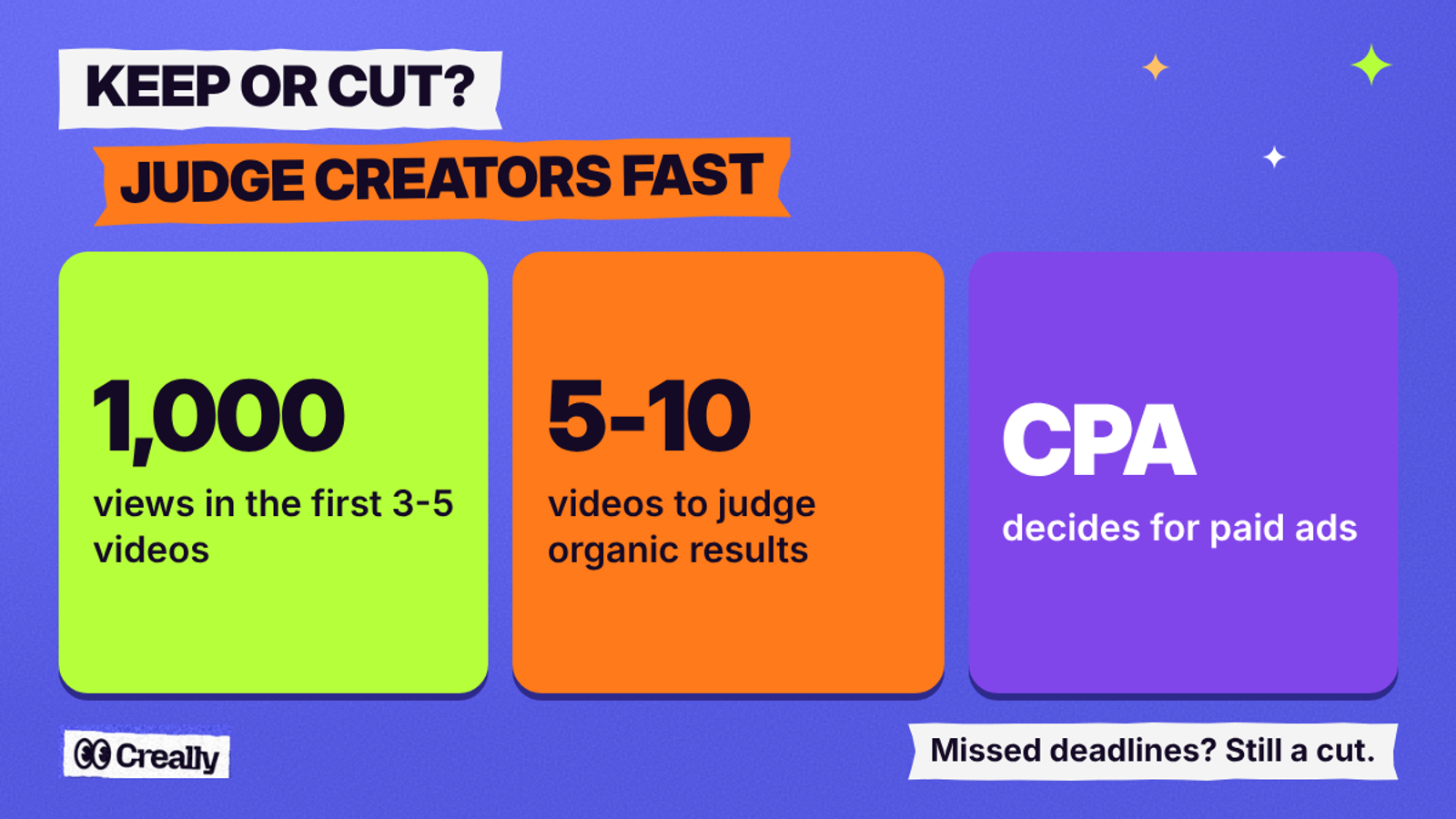
- If a creator can't get past 1,000 views in their first three to five videos, reconsider
- Five to ten videos are usually enough to judge organic performance
- For paid, judge by CPA, keeping in mind that a good CPA for one business can be too high for another
- Reliability matters too, because a creator with great numbers who misses deadlines or disappears is unmanageable
Hook rate - the share of viewers who keep watching after the first few seconds.
Cost per usable asset - what you pay for each video good enough to publish or run as an ad.
Creator win rate - the share of a creator's videos that become top performers.
CPA (cost per acquisition) - the cost of getting one install, signup or paying customer.
Bad Creator or Bad Brief? How to Find What's Really Broken
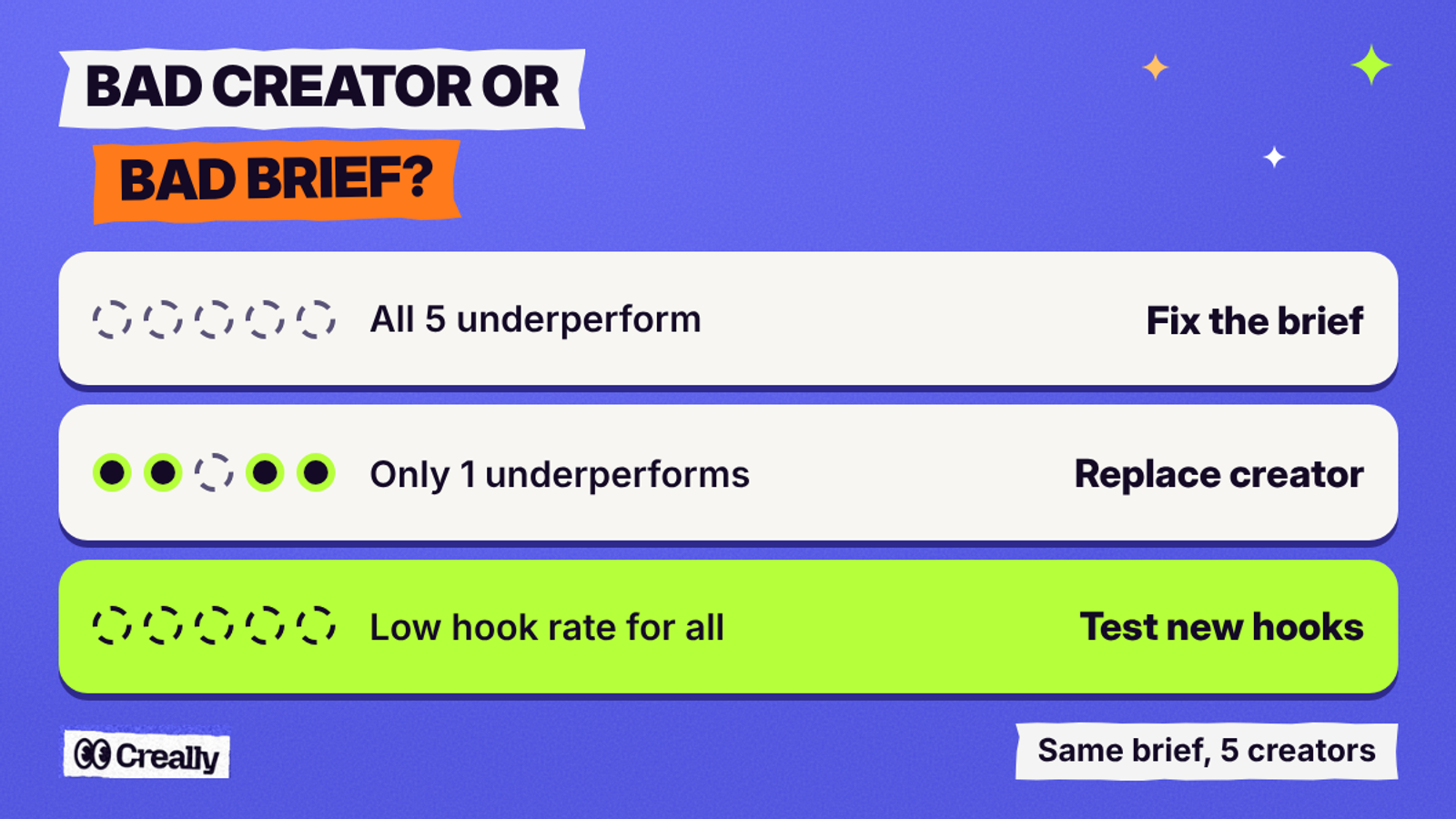
With creators, there are three variables in play. The brief, the creator and the algorithm. The simplest way to isolate them is to give the same brief to five creators and compare the results (34:24).
- If all five underperform, the problem is the brief
- If one underperforms while the others do well, the problem is that creator
- If the hook rate is low across everyone, keep the concept and script and test three new hooks with five creators before changing the whole idea
Creator brief - the instructions a brand gives creators on message, format and requirements.
TikTok, Reels or Shorts? Where to Launch Your Creator Content First
Start by cross-posting the same videos to several platforms. It's the fastest way to see where your content works, because results vary by brand. Some see YouTube take off while TikTok flops, and for others it's the opposite.
Adapt each video for TikTok, Instagram Reels and YouTube Shorts with small tweaks, which AI makes easy today. On YouTube Shorts, use more aggressive hooks and packaging, because people see the preview first and only then decide whether to watch.
Tatiana also expects Instagram to actively push its new long-form video format over the next three to six months. That opens room for in-depth tutorials, educational content and detailed product demos.
Nikita predicts that many YouTube creators will re-upload their long videos to Instagram to reach new audiences.
How to Prove Creator ROI When Attribution Fails
Attribution for organic creator content is still the hardest part, and there's no perfect solution yet. For a deeper dive, see our guide on how to measure influencer marketing revenue in practice.
The most reliable approach is to combine several methods (41:10).
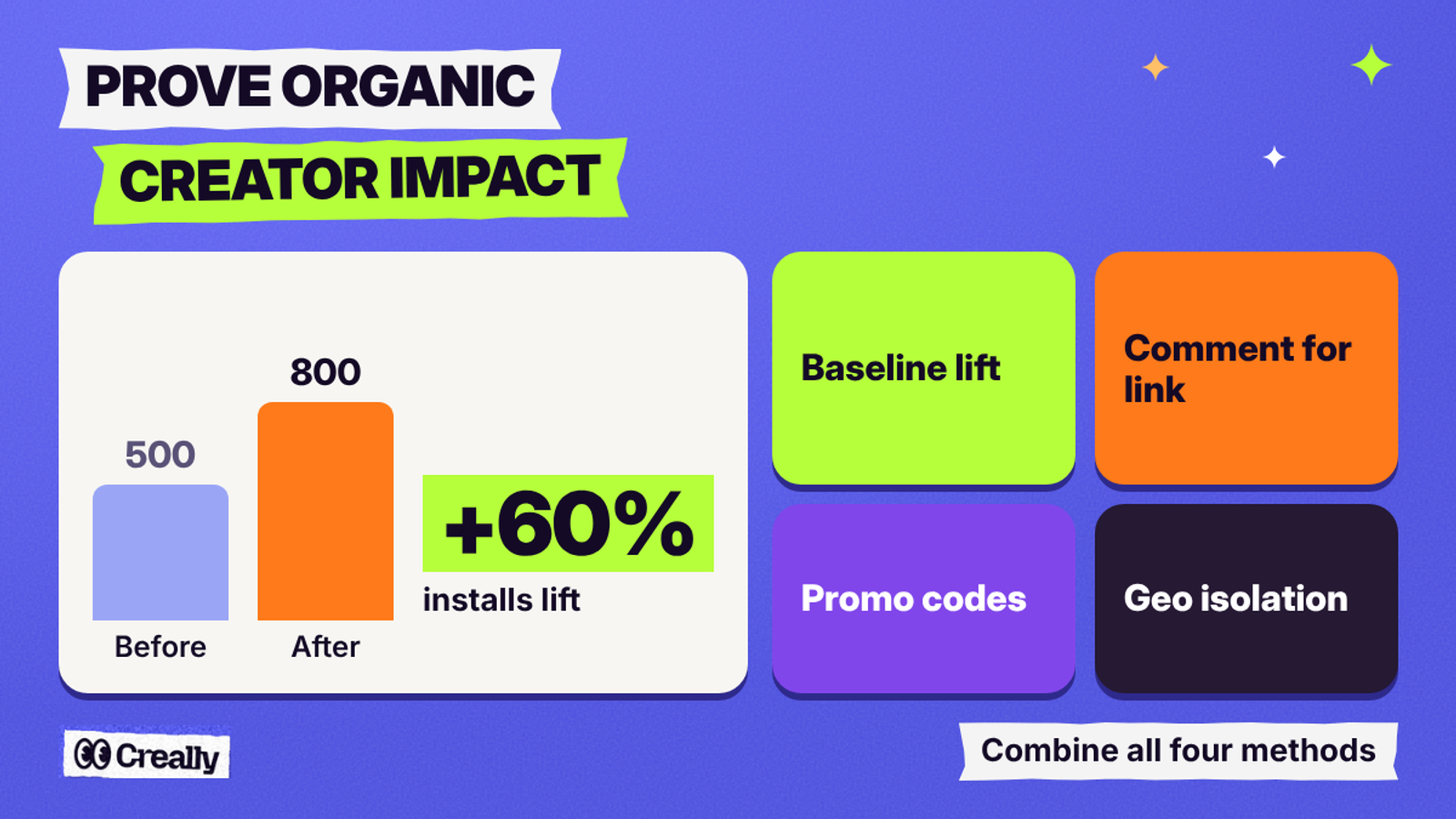
- Organic baseline and lift. Measure your normal organic installs over the previous two to four weeks, then watch the first 24 to 48 hours after a post. If you usually get 500 installs a day and see 800 after a creator posts, that's a 60% lift
- Comment mechanics. A CTA like "comment to get the link" lets you count visits and users from a specific video. OpusClip used exactly this, asking viewers to comment "OPUS" for a free guide and collecting over 53K comment triggers
- Promo codes. Unique discount codes show which creator's audience converted
- Geo isolation. Nikita recommends launching the program in a smaller market where you don't run paid ads. It's cheaper, less saturated and gives you a clean read on organic uplift, although audience behavior may differ from your main market
Attribution - identifying which marketing activity led to an install or sale.
Baseline and lift - your normal level of results and the increase above it after a campaign.
How to Scale From 10 to 100 Creators Without Hiring a Bigger Team
The first step is always to automate operations (47:44). Your team shouldn't spend hours searching for creators, sending outreach messages, chasing replies and managing everything in spreadsheets.
That time should go to creative strategy, testing and scaling winning concepts. Most brands also overestimate how many people they need.
- For 10 creators, one manager is enough
- For a few dozen creators, one manager can still handle it with good processes and automation
- For 100 creators, one strong lead plus two juniors usually works, depending on content volume and complexity
The real bottleneck today is paperwork. Contracts, IP and usage rights, invoices and payouts pile up fast, and nobody wants their creative team spending half a week on admin.
This is exactly the gap Creally's autonomous influencer marketing platform was built to close. It runs a live search across millions of creators, sends outreach from ready-made domains and inboxes, and uses AI agents to negotiate deals on your terms.
It then handles payouts in 180 countries and tracks every published video in a dashboard updated hourly. That way, you can spot top performers fast and double down on them.
3 Creator Marketing Lessons That Save Months of Trial and Error
- Test different creator personas. One team was sure hustle-focused male creators would win and included just one woman in their test batch, and she became their top performer. Nikita has seen the same pattern, with his best creatives often being the ones he personally disliked, so let the data decide
- Don't overcomplicate your first campaign. Simple dos and don'ts and a batch of creators beat a month spent polishing the perfect playbook. Move fast and iterate faster
- Treat the playbook as a living system. Update it after every campaign and use it to onboard new creators, so they quickly learn what works for your brand and what to avoid
One more tip from Nikita. Algorithms change almost every week, so there's no such thing as an outdated learning. A creative that failed a year ago can suddenly work today, which is why it pays to keep a beginner's mindset.
AI vs UGC, Volume vs Depth - Quick Answers to the Biggest Creator Debates
Will AI Creators Replace Real UGC?
AI will replace much of the generic, low-effort UGC. Creators with real personalities, strong storytelling skills and the ability to invent new formats will become even more valuable. We explored this shift in AI influencers vs organic UGC.
10 Deep Partnerships or 50 Fast Ones?
Start with ten deep partnerships. Work closely with these creators, learn their strengths, test concepts and build a proper feedback loop. Once you know what works, scale to 50 or 100. Build the system first, then scale the volume.
Pay Creators for Work or for Results?
Combine both. A fixed fee pays creators for their work, and a performance bonus motivates them to make content that actually performs. It's a win-win.
Own Creator Roster or One-Off Deals With Big Names?
For consistent growth, build your own roster. Your creators already understand your product and audience, produce faster and get better over time.
One-off deals with KOLs still make sense for big launches, special collaborations, reaching new audiences or building trust.
AIGC (AI-generated content) - content made with AI avatars, voices or tools instead of real people.
KOL (key opinion leader) - a well-known figure whose opinion strongly influences their audience.
FAQ About Creators on Retainer
How much do creators on retainer cost?
Creators on retainer usually get a small fixed fee per month or per batch of videos, plus a performance bonus for top results. Exact rates depend on the market, platform and content volume. For real pricing benchmarks, download The Real Cost of UGC in 2026 playbook.
How many creators do I need to start?
Ten creators is a solid start for most brands. A solo founder can see results with just three creators and one strong format.
How quickly can I tell if a creator is working?
Five to ten videos are usually enough to judge organic performance. If a creator can't pass 1,000 views in their first three to five videos, it's time to reconsider.
How many people do I need to manage a creator program?
One manager can handle 10 creators, and even a few dozen with good automation. For 100 creators, one strong lead plus two juniors is usually enough.
Does the retainer model work for B2B?
It works best for consumer products that are easy to show on camera. In B2B, a few industry experts usually perform better than a large UGC network.
Key Takeaways
Stop Gambling on Influencers and Start Building a Creator Engine
Creators on retainer turns influencer marketing from a series of expensive bets into a predictable system. Here's what to remember.
- One-off integrations make you pay a premium for someone else's audience, with no guarantees and no chance to iterate
- A creator network of small accounts can outperform celebrities, as Cantina AI proved with 25.8 million views from accounts with a median of 92 followers
- The best payment model combines a small fixed fee with a performance bonus, so creators are paid for their work and motivated to deliver results
- Optimize for installs and revenue, not views, and make sure your funnel, CTA and branded search are ready before you scale
- Start with around ten creators, test different personas and formats, and document every learning in a living creator playbook
- Judge creators fast, because five to ten videos are usually enough to decide whether to keep or let go
- Measure organic impact by combining baseline lift, comment mechanics, promo codes and geo isolation
- Automate outreach, negotiation, contracts and payouts, so one manager can handle dozens of creators and your team can focus on creative strategy
The brands winning with creators today aren't the ones with the biggest budgets. They're the ones that test faster, learn faster and scale what works.
Ready to build your own creator engine? Try Creally to find creators who are posting right now, reach them in their inbox, negotiate on your terms and track every video in one place.