8 min read

Part 2 of a series on measuring real ROI in influencer marketing.
In the first part of this series, we established that engagement is a comfort metric, something that feels good to measure but fails to tell you whether your influencer marketing actually works. Now comes the harder question: if not engagement, then what?
The challenge is that marketers use undefined terminology and lack clear measurement frameworks, causing misalignment between marketing and finance teams.
The ROI Definition Problem
Different marketers define ROI differently—measuring engagement, reach, click-through rates, or revenue. ROI has a specific meaning: it's the ratio of profit generated to money spent. In its simplest form, it's (Revenue - Cost) / Cost.
If you spend $10,000 on a campaign and it generates $30,000 in revenue, your ROI is 200%. If it generates $8,000, your ROI is negative 20%. Tracking costs is straightforward but attributing revenue to influencer activity is problematic.
Why Revenue Attribution Is Hard (But Not Impossible)
Revenue attribution in influencer marketing is genuinely difficult, and anyone who tells you otherwise is either lying or selling something. The challenges are real and structural:
The attribution window problem
Customers have multi-week journeys from initial impression to purchase. Different attribution models—last-click vs. first-click—assign credit differently, making it hard to know which touchpoint actually drove the sale.
The cross-device reality
Customers view content on phones but purchase on laptops, breaking the connection between impression and conversion in most analytics systems.
The offline conversion gap
Purchases in physical stores following online influencer exposure remain untracked, creating a significant blind spot in attribution data.
The word-of-mouth multiplier
One viewer can tell multiple people, creating conversions well beyond the direct view count—a multiplier that traditional tracking systems cannot capture.
The brand halo effect
Cumulative brand awareness from multiple creator mentions over time makes single-source attribution nearly impossible.
These aren't edge cases—they're fundamental characteristics of how influencer marketing works. But 'nearly impossible' isn't the same as 'not worth trying.' The goal isn't perfect attribution, it's good enough attribution to make better decisions than you would make using engagement metrics alone.
The Hierarchy of ROI Measurement
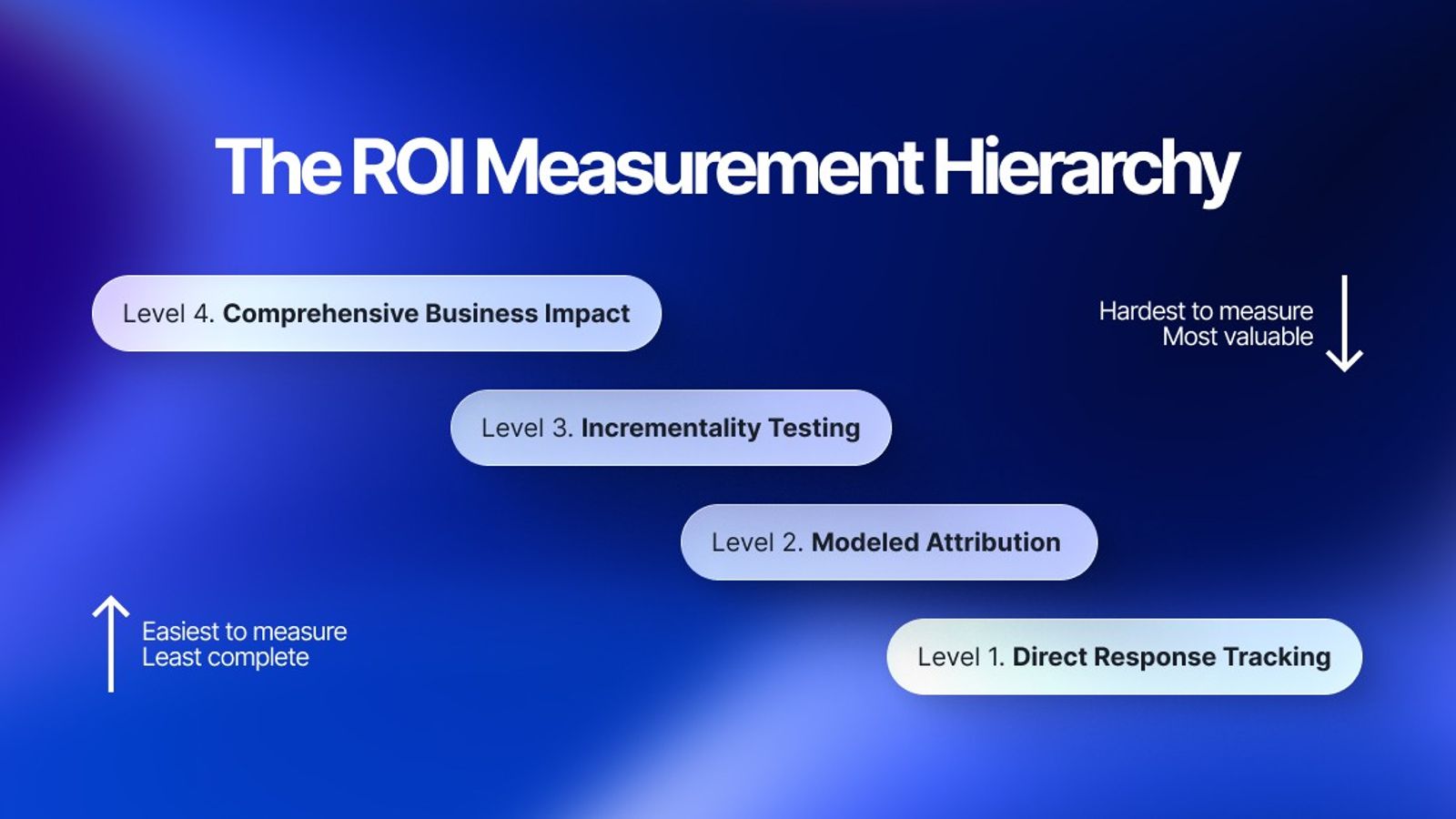
Since perfect attribution is impossible, you need a practical framework for measuring ROI that acknowledges limitations while still providing actionable insights. Think of it as a hierarchy, where each level gets progressively harder to measure but provides progressively more valuable information.
Level 1. Direct Response Tracking
Using unique discount codes and tracking links with 7-30 day attribution windows. This is relatively easy to implement but systematically undercounts influence. If you spend $10,000 and your tracking links show $15,000 in revenue, your measured ROI is 50%. But your actual ROI might be 150% once you account for untracked conversions.
Level 2. Modeled Attribution
Analyzing sales data correlations with influencer activity and using multi-touch attribution models to assign partial credit across customer journeys. The results are only as good as your assumptions, but this provides a more complete picture than direct tracking alone.
Level 3. Incrementality Testing
This is the gold standard—the closest you can get to knowing true causal impact. Holdout group testing runs campaigns in some regions but not others. If you spend $50,000 on a campaign and sales increase by $100,000 in test regions while staying flat in control regions, you have strong evidence of a 100% ROI. It requires sophisticated setup, significant scale, and time, but delivers the most reliable results.
Level 4. Comprehensive Business Impact
This level incorporates customer lifetime value, brand awareness shifts, cost per acquisition comparison, and market share movement. Very few companies operate at this level, but it represents the most complete view of influencer marketing's true business impact.
What "Good" ROI Actually Looks Like
Once you have measurement systems in place, you face another question: what constitutes good ROI for influencer marketing? Context matters enormously. A direct-to-consumer brand selling $200 products with 60% margins can afford to accept lower ROI than a marketplace platform that takes a 15% commission.
Compare to your other channels
If paid search delivers 300% ROI and influencer marketing delivers 100% ROI, that doesn't necessarily mean influencer marketing is failing—it means it's less efficient than search. Channel comparison gives you context for what "good" means in your specific situation.
Account for scale limitations
Smaller high-ROI channels may be less valuable than larger lower-ROI ones due to total profit potential. A channel with 500% ROI on $10,000 spend generates less profit than one with 150% ROI on $1,000,000 spend.
Factor in strategic benefits
Content assets, creator relationships, and community sentiment represent additional value beyond direct ROI that doesn't show up in conversion tracking but contributes to long-term brand health.
Consider maturity curves
Early campaigns often have lower ROI. ROI typically improves as you optimize based on data, so don't judge the channel by your first few campaigns.
As a rough benchmark, most sophisticated e-commerce brands expect 150-300% ROI from mature influencer programs when using direct attribution, with the understanding that actual ROI including untracked conversions is likely higher.
The Attribution Honesty Gap
Here's an uncomfortable truth: even with sophisticated measurement systems, you will never know the exact ROI of your influencer marketing with perfect precision.
There are two traps to avoid. The first is perfectionism: "We can't measure ROI perfectly, so we'll just stick with engagement metrics." This is choosing comfort over clarity. The second is false precision: "Our dashboard says this campaign delivered exactly 247% ROI"—which ignores real attribution limitations.
The right approach acknowledges uncertainty while still driving toward better measurement: "Our direct tracking shows 180% ROI, we know this undercounts actual impact, our incrementality test suggests the true number is probably 250-300% ROI, and compared to our other channels this performance justifies continued investment and testing."
This is what measurement maturity looks like. Not perfect numbers, but honest ones. Not false precision, but useful ranges. Not comfort metrics that hide reality, but imperfect metrics that illuminate it.
From Measurement to Optimization
Understanding what ROI means and how to measure it is necessary but not sufficient. The real value of ROI measurement comes from what it enables: systematic optimization.
With revenue data, you can answer questions that engagement metrics can never address:
- Which creators drive the most revenue per dollar spent?
- What types of content convert best?
- How does performance vary by product category, audience demographic, or seasonal timing?
- Which creator relationships should you deepen and which should you end?
- Where should you allocate incremental budget for maximum return?
This is the shift from art to science, from gut feeling to data-driven decision making. You stop choosing creators based on follower counts and start choosing them based on proven revenue performance.
The brands that have scaled influencer marketing into eight-figure revenue channels didn't get there by having perfect measurement. They got there by having good enough measurement to know what was working and doing more of it while cutting what wasn't.
Setting Up for Success
If you're ready to move from engagement metrics to real ROI measurement, the practical implementation starts with three foundational steps:
First, implement direct tracking
Give every creator unique discount codes or UTM-tagged links. Set up proper attribution windows in your analytics (30 days is standard, but test what makes sense for your consideration cycle). Ensure your e-commerce platform or CRM can connect purchases back to creator sources.
Second, establish your measurement framework
Decide which measurement level to target and what resources to commit. Smaller brands may start at Level 1 direct tracking, while larger brands with more resources may invest in modeled attribution or incrementality testing.
Third, define your success metrics and targets
What ROI threshold makes influencer marketing worth scaling for your business? How will you compare influencer performance to other channels? What time frame will you use to evaluate success? The specific tools and platforms you use matter less than the discipline of consistent measurement.
The Honest Conversation About ROI
Moving from engagement to revenue measurement requires having honest conversations—with your team, with executives, and with the creators you work with.
With your team: "We've been celebrating engagement wins, but we don't actually know if we're making money. That changes now. We're going to implement better tracking, and some campaigns that looked successful might turn out not to be. That's okay—we're learning."
With executives: Be honest that measurement will be imperfect but improved, and that the goal is making better allocation decisions than you could with engagement metrics alone.
With creators: Explain the performance-based evaluation approach while maintaining authentic content and creative freedom. Transparency builds better long-term relationships.
These conversations are uncomfortable but necessary. The alternative is continuing to operate in the comfortable fog of engagement metrics while your actual business performance remains unknown.
What's Next
The next article (Part 3) will cover tactical implementation—the specific systems, tools, and processes for implementing revenue attribution in practice. Topics will include:
- Tracking infrastructure
- Attribution models
- Technical challenges
- Dashboards that drive decisions
- Creator resistance to tracking links
- Multi-creator campaigns
- Measuring awareness-focused content
Because knowing you should measure ROI is one thing. Actually doing it is another.
The gap between engagement and revenue is real but not insurmountable. It just requires facing reality rather than hiding behind comfort metrics. Start by asking not 'how much engagement did we get?' but 'how much revenue did we generate, and how do we know?' That question changes everything.
This is Part 2 in a series on measuring real ROI in influencer marketing. Coming next: 'How to Measure Influencer Marketing Revenue in Practice,' where we'll walk through the specific systems and processes for implementing attribution, from basic tracking setup to sophisticated measurement infrastructure.