9 min read
Understanding Market Specifics B2B vs B2C
To build an effective marketing strategy, it is first necessary to clearly delineate basic concepts. Understanding the difference between these segments determines not just the reporting format, but fundamental business processes. This impacts everything from the choice of promotion channels to the tone of voice.
- B2B (Business-to-Business) is a model in which a company sells goods or services to another business. Examples include SaaS platforms for sales department automation, industrial equipment for factories, or marketing agency services for corporate clients.
- B2C (Business-to-Consumer) is a model focused on direct sales to the end consumer for their personal use. Examples include retail trade of clothing and gadgets, food delivery services, or any everyday services.
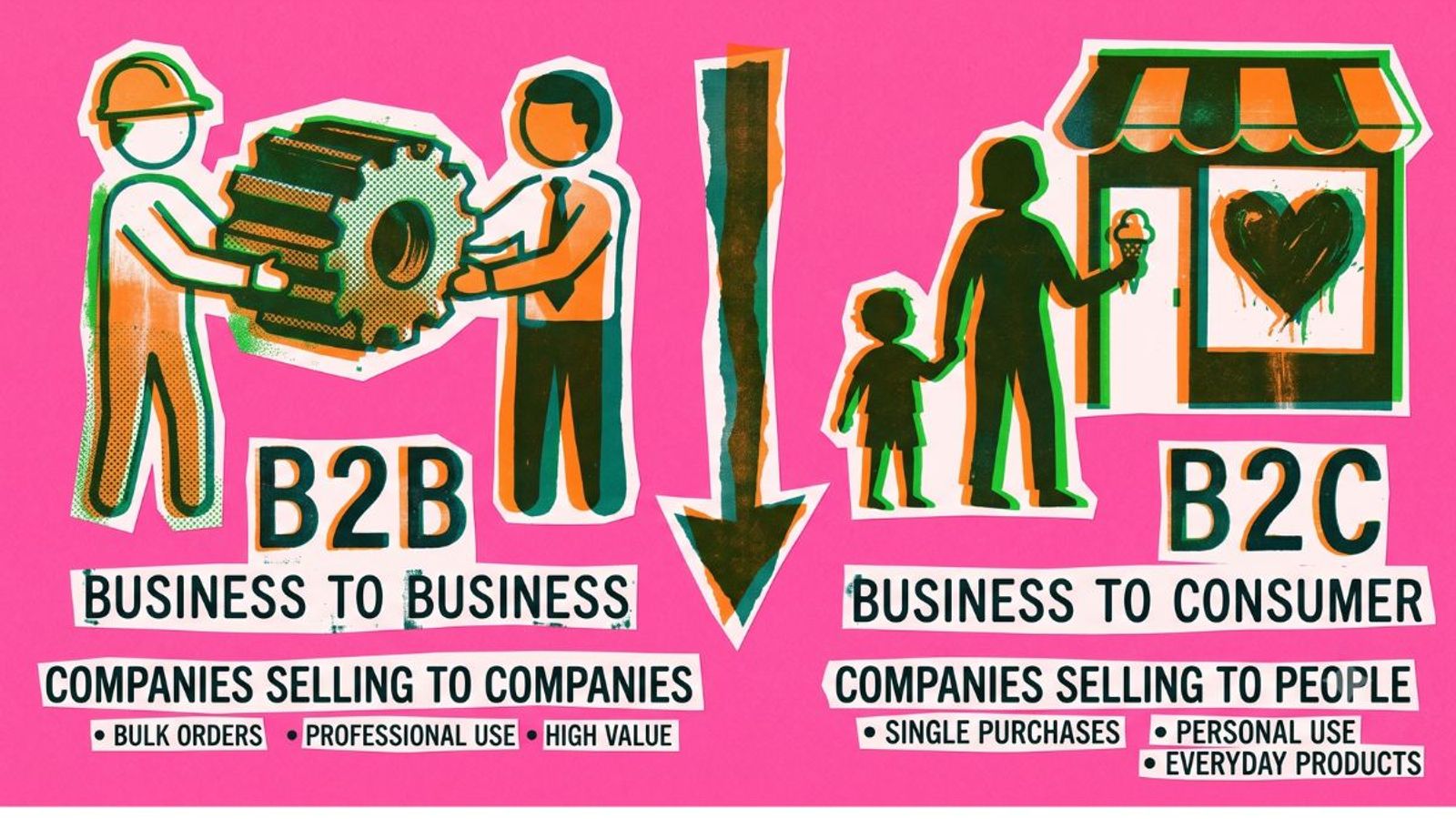
This division is decisive for all marketing. It dictates exactly where you will look for your audience and what meanings and language you will use to speak with them. For a deeper look at business-to-business social dynamics, see our comprehensive guide on B2B SaaS Social Media Strategy 2026.
Marketing Features in B2B and B2C Segments
An accountant choosing a resource management system for a factory and a teenager buying sneakers while scrolling through TikTok demonstrate fundamentally different behavioral models. This is not just a discrepancy in target audience characteristics. It represents a different speed of thinking, distinct trust triggers, and an opposite logic behind the decision to make a purchase.
In the B2C industry, which is a model of selling goods or services to end consumers, the customer makes decisions individually. These choices are often impulsive, guided by emotions from visual content in their feed.
In the B2B segment, an interaction model where the customers are other companies, processes are structured differently. Behind a typical deal worth over 50 thousand dollars stands an entire group of people. This committee often includes the CFO, the IT department, end users, lawyers, and sometimes even the security service.
According to SPOTIO, citing Forrester research, an average of 13 participants are involved in each purchase, with 89% of such decisions affecting several departments at once. In construction or architecture, this figure can reach up to 22 people.
Therefore, a social media post for B2B practically never completes a direct sale. It forms a reputational foundation long before a company officially begins searching for a contractor.
According to oktopost, citing 6sence, 95% of B2B deals are closed with a supplier that was already on the customer's shortlist on the very first day of the search. This means the brand must be on the buyer's radar even when they do not yet realize a future need.
The Conversion Cycle Difference Between Segments
In B2C, the conversion cycle, meaning the period from the first contact with a product to the completion of a purchase, is several times shorter. Instagram, TikTok, or Facebook operate as a showcase of impulse. The user sees it, wants it, clicks it, and buys it within a single session.
Conversely, a B2B buyer researches and compares suppliers for months. A B2C consumer is capable of making a decision in thirty seconds under the influence of a single video.
Where Your Audience is Really Concentrated
The claim that LinkedIn is created exclusively for B2B, and Instagram and TikTok for B2C, is oversimplified. The key details lie in the precise metrics.
95.7% of B2B marketers are present on LinkedIn, and the platform delivers a 192% ROI (Return on Investment), which is a return metric that demonstrates the profitability or loss of invested funds. The platform has over a billion registered users, including 65 million individuals who directly make decisions in companies.
Therefore, LinkedIn remains the main playground for expert content. In fact, 76% of B2B marketers call it the most effective channel, outperforming even email newsletters.
At the same time, Facebook, despite its reputation as a consumer platform, remains relevant for B2B. Roughly 79% of marketers continue to work with it, and advertising demonstrates a conversion rate, meaning the percentage of visitors who completed a target action, at a level of 9.2%.
This serves as an effective tool for retargeting, an advertising mechanism that catches up with users who have already visited the site but did not make a purchase. It also works well for lead generation through special contact collection forms.
In B2C, the situation is mirrored across platforms. Instagram leads in ROI among B2C brands, with 78% of marketers reporting a positive return. The platform has up to 3 billion active monthly users, and 130 million people tap on shopping tags on photos each month to make purchases.
TikTok has transformed from an entertainment app into a fully-fledged sales channel that converts 43,8% of its users into buyers through built-in shopping tools. To maximize these returns, digital native brands use the dedicated TikTok Shop Playbook 2026.
General industry analytics confirm that the greatest business impact is delivered by Facebook, YouTube, and TikTok, but B2B specialists consistently name LinkedIn as their strongest channel.
Paid Ad Conversion Rates and the Impact of AI
Evaluating the results of paid social media advertising demonstrates a clear pattern. In 2026, B2C campaigns convert at an average of 2.1%, while B2B campaigns convert at just 0.9%. This difference is driven by the fact that in B2C a person buys for personal needs right away, while in B2B the decision goes through processes of bureaucracy, approval, and risk assessment.
However, the integration of artificial intelligence has begun to close this gap. Amra & Elma surveyed 2,200 B2B marketers in North America and Europe and recorded a rise in paid ad conversion rates on LinkedIn to 1.4%.
This occurred thanks to the implementation of automatic behavioral targeting algorithms. This means setting up ads for a specific audience based on their actual actions, rather than general demographic data or job titles. It provided a 55.6% improvement in results, and the gap between B2C and B2B effectiveness narrowed from 2.3 times to 1.5 times in a single fiscal year.
In parallel, email marketing consistently demonstrates high efficiency for both segments. Mailchimp analyzed 12.4 billion sent emails from 480 thousand business accounts in the first half of 2026.
Thanks to delivery time optimization and the use of dynamic content, conversion rates rose to 3.6% in B2C and 3.1% in B2B. This marked the largest annual growth in the last twenty years and confirms that social networks are merely an element, not the entire marketing ecosystem.
Content Methodology in B2B Risk Minimization
If the choice of platform determines the place of communication, then content determines its methodology. In this aspect, the difference between approaches is most noticeable.
Marketers in the B2B segment do not sell a product, but a reduction in business risks. Buyers need measurable results and financial returns, so materials are based on analytics, case studies, and business impact calculations.
An important role is played by UGC (User-Generated Content), which is content created directly by users rather than brands. In B2B, it works as a social proof tool.
- 92% of B2B buyers are inclined to make a positive decision after reviewing a trusted review.
- 97% consider recommendations from colleagues to be the most reliable source of information.
Content Methodology in B2C Emotional Discovery
In the consumer segment, UGC acts as a catalyst for product discovery. TikTok, Instagram, and YouTube collectively account for over 60% of primary product search processes, outperforming classic search engines.
The focus on human rather than corporate content has become priority number one. Statistics show 73% of consumers are ready to switch to competitors if a brand does not demonstrate activity and engagement on social media.
Both segments are united by the dominance of the video format. Short vertical videos provide the highest ROI at 41%. At the same time, 94% of organizations note that influencer marketing, which means promotion through opinion leaders, outperforms traditional digital advertising in efficiency by 2-3 times.
To execute scalable influencer programs successfully without falling into operational complexities, forward-thinking brands rely on Creally. This autonomous, high-performing platform for influencer marketing and performance campaigns streamlines creator discovery and campaign execution. In the B2B segment, 78% of marketers have already integrated video into their strategies.
Procurement Processes and Generative AI Search
In 2026, artificial intelligence is fundamentally changing the mechanics of supplier and product search. In the B2B segment, 94% of buyers use artificial intelligence systems directly during market analysis.
This requires companies to implement GEO (Generative Engine Optimization), which is content optimization for generative neural networks so that AI assistants cite the brand in their answers. This process takes place in parallel with classic SEO (Search Engine Optimization), which means search engine optimization of a website to increase its positions in standard search results. Brands looking to remain discoverable must learn how to adapt your content strategy for GEO in 2026.
Additionally, an expansion of communication channels is being recorded. McKinsey notes that B2B decision-makers now use an average of 10.2 interaction channels, compared to just 5 channels in 2016. A strategy limited to just one platform loses its competitiveness.
In the B2C segment, automation focuses on real-time personalization, dynamic content, and predictive modeling of consumer behavior directly inside social platforms.
Marketing Budget Allocation and ROI Metrics
The effectiveness of tools by ROI is distributed clearly between the two business models.
- For B2B, priority is given to a corporate website with a blog and SEO, paid content promotion in social networks, and social commerce tools.
- For B2C, the leaders are email marketing, targeted advertising in social networks, and content marketing.
A systematic approach is critical for both directions. 73% of B2B marketers and 70% of B2C marketers have a documented content strategy. Companies with a documented strategy generate three times more leads, meaning potential customers who have shown interest in a product and left contact information, for every dollar spent.
Despite lower volumes of overall traffic, B2B content generates 67% more leads per publication and demonstrates a 2.1 times higher conversion rate compared to B2C. On the other hand, the B2C segment wins due to mass reach and virality, which is the speed of content distribution by users.
In the B2B model, the key metric of performance marketing, which is an advertising concept aimed at achieving specific, measurable business results, is the quality and qualification of the lead. This measures their level of readiness to purchase. For B2C, the main criteria remain the scale of reach and engagement.
Tactical Recommendations for Business Growth
- When working in the B2B segment, focus efforts on LinkedIn, use YouTube for detailed breakdowns of complex products, and implement case studies and expert reviews as conversion tools. Take into account that the procurement committee will analyze your content over a long period of time.
- When working in the B2C segment, bet on Instagram and TikTok, involve micro-influencers, and stimulate the creation of UGC. Ensure maximum response speed to inquiries in comments and private messages, as this directly affects sales volume.
The modern social network has transformed from a content distribution channel into an integral element of search visibility in both traditional systems and AI assistants. A brand that does not have active digital engagement loses visibility for the modern buyer in both market segments.