6 min read

2026 Brand Deals Report: Why a One-Size-Fits-All Influencer Strategy Fails at Scale
Every growth marketer and CMO scaling user acquisition in global markets regularly faces the challenge of inefficient budget allocation across key social media channels. This is exactly why on the pages of our blog, we systematically analyze big data and dissect the architecture of influencer marketing as a predictable revenue ecosystem, helping businesses shift from chaotic manual experiments to automated, managed scaling. Today, our focus is on the latest Brand Deals Report, created by The Influencer Marketing Factory using Modash's analytical database. Researchers analyzed over 316,000 sponsored posts and verified data from thousands of English-speaking creators, focusing heavily on the United States market. This analysis is vital for Performance Directors, brand managers of international E-commerce projects, and mobile app marketing teams, as it clearly demonstrates how the unique characteristics of specific platforms dictate the financial efficiency of the entire marketing mix. To dive deeper into the terminology and metrics of such large-scale studies, you can explore our comprehensive Influencer Marketing Glossary, which gathers key definitions to help set up an effective workflow.
Influencer Retention and Platform Dynamics
The main conclusion of this study aligns perfectly with the Creally philosophy: the market has completely outgrown the format of accidental integrations and now demands a profound analysis of retention mechanics. The most striking gap identified by analysts lies in the Creator Lifetime Value across different platforms. YouTube emerged as the premier channel for building long-term, predictable sales systems, boasting an average partnership length of 13.5 months, with the repeat collaboration rate exceeding 50.9%. The secret behind this loyalty lies in the platform's unique deal structure, with over 52.9% of contracts on YouTube operating on an affiliate-first, performance-based model. Creators earn commissions on actual conversions via referral links and tracking codes, which automatically aligns the financial interests of both the brand and the creator, turning each integration into a long-term asset. For practical insights on how to implement this approach into your marketing mix, we have laid it all out in our guide on Scaling influencer marketing as a revenue system.
In contrast, TikTok remains a space for fast and often one-off activations, where nearly 71.8% of deals end after the very first post, and the average collaboration length does not exceed 4.9 months. A flat-fee payment model dominates this platform, forcing creators to focus on instant reach and algorithmic trends rather than long-term audience conversion. Instagram occupies a similar position, showing around 68.5% of one-off deals.
To simplify your choice of creator retention strategy, experts highlight the following key platform performance factors:
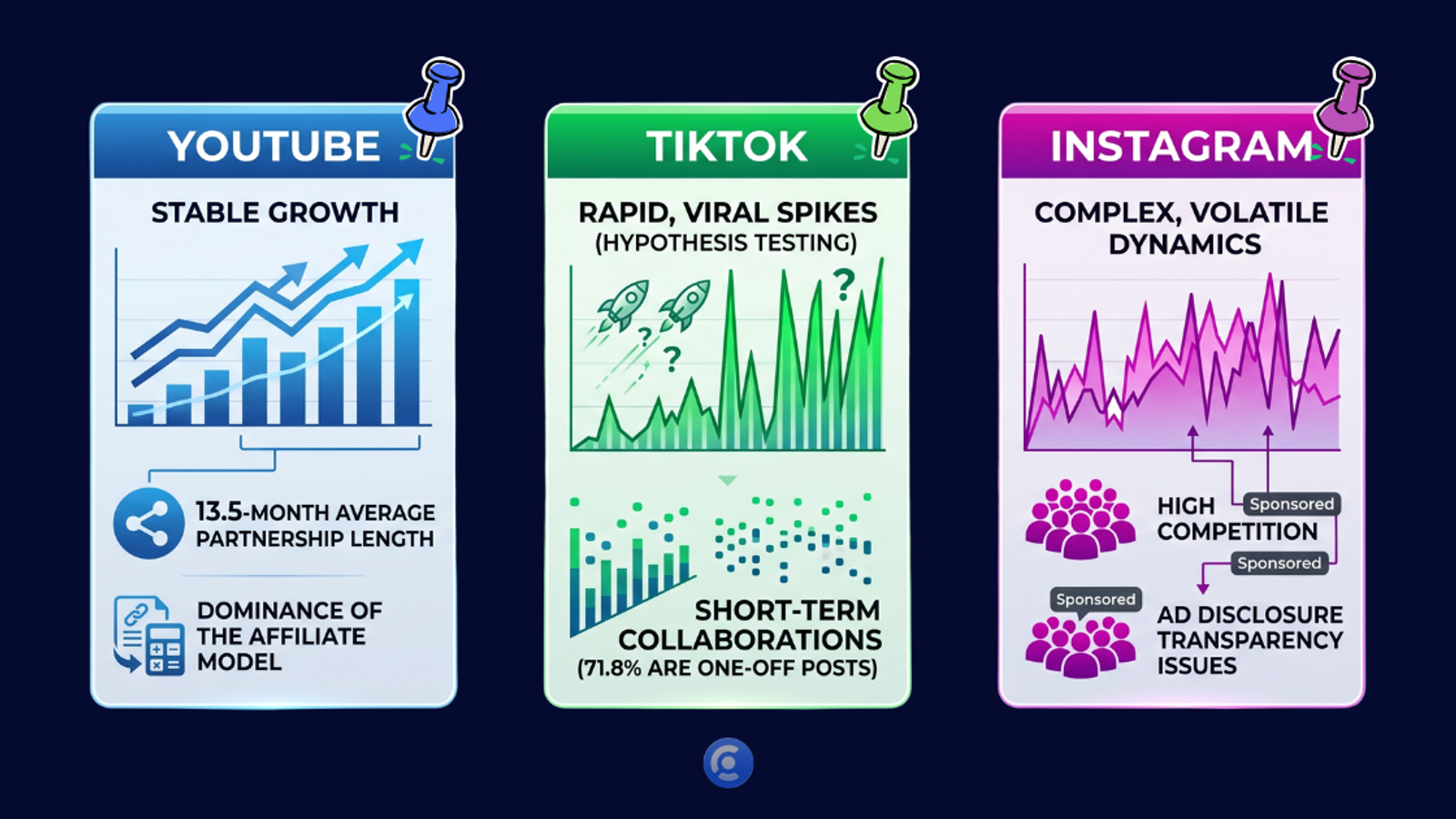
- YouTube delivers maximum partnership lifetime value due to its performance-tied model and deep-dive content style.
- TikTok functions as an excellent tool for rapid hypothesis testing or massive initial audience acquisition.
- Instagram requires extra effort to retain creators due to high competition for talent attention.
From this, a crucial intermediate conclusion emerges: launching long-term ambassador campaigns on TikTok or Instagram without proper automation and data analysis carries a high risk of poor creator retention, while YouTube inherently offers a higher return on investment over the long haul. However, the landscape on TikTok is changing rapidly due to the expansion of built-in commercial features, so to grasp the new rules of the game on this platform, it is well worth studying our latest TikTok Shop Playbook 2026.
The Ad Disclosure Compliance Crisis
The next critical challenge for global brands is the crisis of legal compliance and ad disclosure, which can lead to severe financial losses under the strict regulations of Western markets. The Federal Trade Commission is tightening sanctions for hidden advertising, and platforms show completely different levels of readiness for these rules. According to the original Brand Deals Report, TikTok turned out to be the compliance leader, with over 52% of sponsored posts properly disclosed through official platform tools thanks to rigorous internal controls. At the same time, Instagram has become a high-risk zone, with only 29% of posts featuring clear disclosures, while over 55.8% of sponsored content is classified as likely hidden.
When creators integrate promo codes or commercial call-to-actions without using official paid partnership tags, it creates additional risks of missing expected performance goals. In today's landscape, manually searching for creators and verifying their credibility is virtually impossible. This forces companies to transition to intelligent solutions and leverage the official Creally website, which helps find relevant creators, automate communication with them, and verify their real analytics to safeguard marketing investments.
Navigating Platform Seasonality
Seasonality analysis shatters another popular myth regarding the existence of a single, universal media calendar for international campaigns. Although Q4 traditionally absorbs around 30% of annual marketing budgets due to global holiday sales, each platform has its own unique monthly pulse.
The monthly budget distribution breakdown looks like this:
- January is the peak month for TikTok, accounting for over 12.1% of the annual content volume due to dropping ad traffic costs.
- May represents the lowest point of activity and integration volumes for TikTok, dropping down to just 5%.
- November becomes the golden period for Instagram, where ad volumes hit 9.9% driven by Black Friday fever.
- December pushes YouTube to its maximum positions with an 11.4% share on the wave of long-form holiday review videos.
The ultimate takeaway from analyzing seasonal fluctuations is that attempting to run a unified campaign across all three channels on a single schedule will guarantee you miss the peak activity windows on at least two out of the three platforms.
Micro vs. Macro Influencer ROI at Scale
When it comes to scaling creators, the report confirms the effectiveness of a differentiated approach based on audience size.
A comparative analysis of creator categories indicates the following:
- Micro-influencers maintain the lead in terms of ROI due to their highly targeted niche audiences and deep engagement levels.
- Micro-influencer audiences perceive sponsorships as trusted advice within a specific niche, making these creators ideal for Performance campaigns.
- Macro-influencers demonstrate a significantly lower engagement percentage and demand much larger budgets.
- Macro-influencers remain indispensable at the scaling stage to secure mass market coverage and build an omnipresence effect in the information space.
Ultimately, winning in this landscape requires integrating these channels into a flexible, data-driven framework where every creator tier and platform matches your target unit economics.
Final Takeaways: Platform Blueprint for 2026
- Channel Strategy. Stop running a unified multi-platform calendar. Use TikTok for fast top-of-funnel validation and rapid hypothesis testing, Instagram as a visual storefront, and YouTube as your primary channel for long-term ROI and predictable revenue scaling.
- Contract Structure. Shift your long-term budgets toward YouTube. Its 13.5-month average partnership length and 50.9% repeat rate, driven by an affiliate-first model, offer the highest Creator Lifetime Value (LTV) in the ecosystem.
- Compliance Risk. Treat Instagram as a high-risk zone for compliance. With 55.8% of sponsored posts likely hidden, manual verification is dead. Use automated data tools to vet creator credibility and avoid regulatory penalties.
- Budget Timing. De-synchronize your ad spend to capture platform-specific traffic dips and peaks. Front-load TikTok budgets into January (12.1% peak volume), maximize Instagram spend in November (9.9%), and lock in YouTube integrations for December (11.4%).
- Scale Execution. Balance your creator tiers by objective. Deploy micro-influencers to secure tight unit economics and niche conversions, then deploy macro-influencers exclusively when you need mass market ubiquity and immediate top-of-funnel volume.
To see how you can automate your global creator discovery, streamline multi-channel workflows, and access real performance analytics, book a demo with Creally today.