7 min read
Colleagues, let’s skip the fluff. If you are a DTC founder, a performance marketing lead, or the solo marketer in a lean team, we share a common pain: Meta Ads is no longer buying you a new Lamborghini. Targeting in the US has turned into a scorched earth of skyrocketing CAC, and iOS privacy updates have completely decimated traditional attribution, according to industry-wide analytics. The only channel still pulling its weight in 2026 is creators, who nearly doubled their share of orders during Cyber Week.
But here is where you run into a brutal dilemma:
- Option A. Fork over a $15,000 monthly retainer to an agency that will just burn your budget on overpriced macro-influencers just to pad their own commission.
- Option B. Manually scale nano- and micro-influencers, sentencing your team to complete burnout in an operational hell of Excel spreadsheets and ignored DMs, as research across lean marketing teams confirms.
It is time to stop choosing between bleeding margin and operational nightmare. Below is a step-by-step breakdown of how to deploy a fully autonomous influencer program on a minimal budget without a single middleman by leveraging the official Creally platform.
The In-House Influencer Trap: Why Traditional Agencies Kill Your Margin and Manual Scaling is a Dead End
Traditional influencer marketing agencies in the US operate on business models that run completely counter to the profitability of DTC brands. The most common setup charging a percentage of the media spend (usually 15–30% of creator payouts) creates an artificial incentive to bloat budgets. Agencies are financially incentivized to book expensive macro-influencers over cheaper, higher-performing micro-collaborations simply because a higher contract value inflates their fee. Alternative models like hefty monthly retainers ($5,000–$30,000) or one-off project fees ($10,000–$75,000) completely lack flexibility, turning into fixed overhead costs that cannot be optimized during seasonal sales slumps.
In an effort to save margins, roughly 66% of brands in 2026 are opting to pull their influencer programs entirely in-house, according to the annual report by Syncly.However, without automation technology, this move quickly turns into an operational swamp. Financial analysts often look only at the base annual salary of a hired specialist ($60,000–$120,000) and view it as a cost-effective alternative to an agency retainer. In reality, the true cost of employment in the US is significantly higher, creating a massive talent overhead. For a deeper look into how this affects teams globally, explore our analysis on the Influencer Marketing 2026 Salary Crisis.
The biggest hidden resource burned by manual in-house marketing is your team's time. Market data shows that over 40% of an in-house coordinator’s workday is swallowed up purely by top-of-funnel tasks: hunting for creators, scraping contact info, drafting individual outreach emails, and chasing down terms. When you factor in annual licensing fees for legacy influencer software ($5,000–$30,000/year) and legal costs for contract drafting ($2,000–$10,000), the economic viability of a manual in-house approach completely evaporates.
The New Performance Playbook: The AI Revolution, Nano-Influencers, and Full Workflow Automation
The era of glossy macro-influencers with million-plus follower counts is over. In 2026, performance marketing is driven by entirely different numbers: nano- (under 10k followers) and micro-creators (10k–100k) deliver the highest engagement. On TikTok, nano-creators average an ER (Engagement Rate) of 11.9%, while on Instagram it holds steady at 2.19%. By comparison, mega-influencers rarely break past the 1% threshold.
This massive gap comes down to consumer psychology: a recommendation from a smaller, niche creator feels like genuine advice from a friend rather than a paid ad. Furthermore, nano- and micro-influencers make up over 75.9% of all profiles on Instagram, providing an infinite testing ground for marketing hypotheses.
Simultaneously, the perception of creativity has shifted dramatically. Polished, studio-quality ads don't sell anymore. The real driver of conversions is raw, phone-shot User-Generated Content (UGC) that blends seamlessly into social feeds. Over 79% of consumers state that authentic UGC directly impacts their final purchasing decisions. Successful brands have abandoned micromanagement; instead of rigid scripts, they provide creators with agile briefs (focusing on the core value proposition + CTA), leaving the creative execution entirely up to them. Brands looking to stay ahead must understand this shift, particularly The Evolution of AI Influence and Organic UGC.
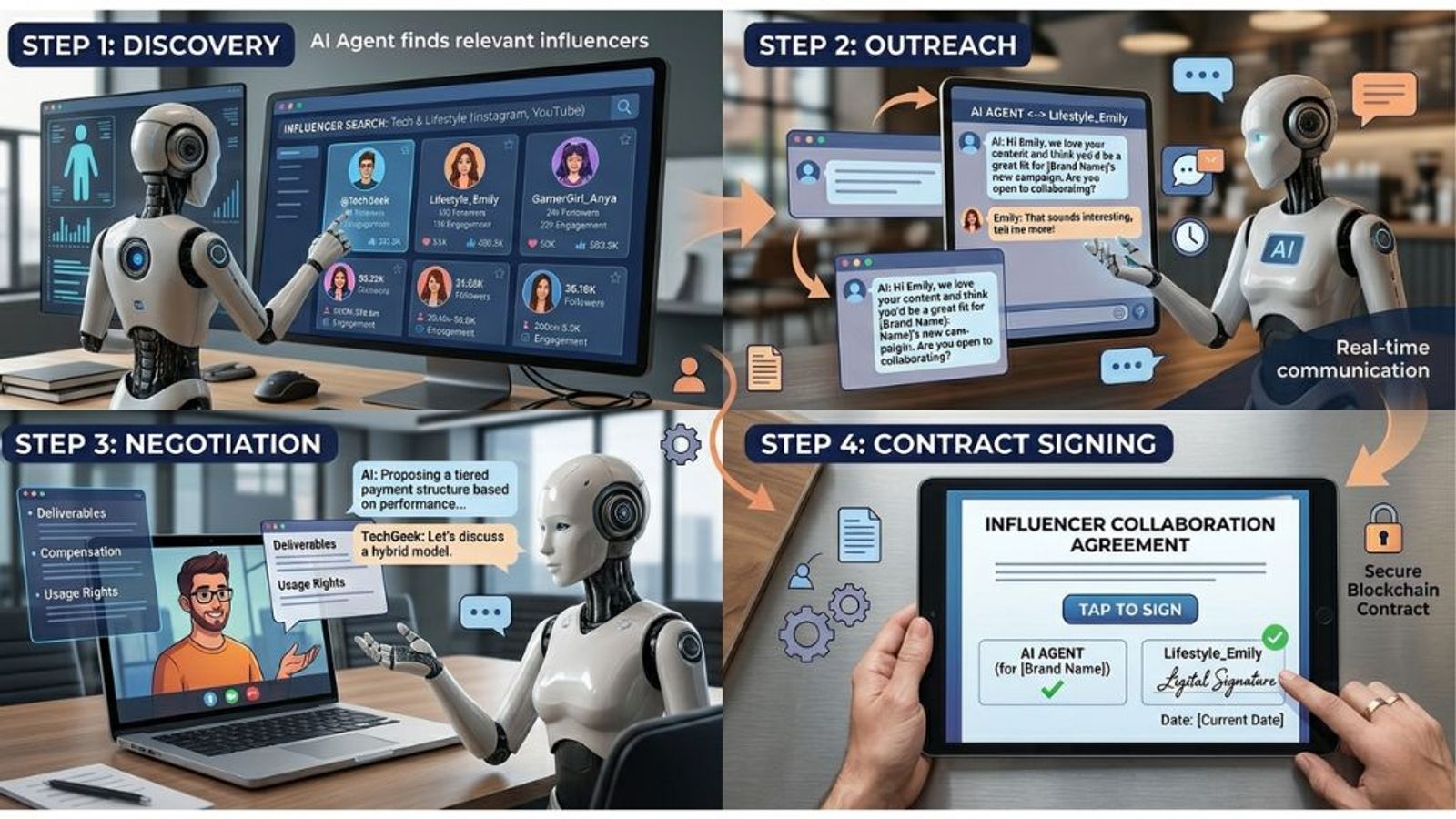
The ultimate challenge for lean teams is figuring out how to manage dozens of these creators simultaneously without scaling headcount. The solution lies in end-to-end automation and the deployment of autonomous AI agents. Instead of manual scrolling, modern growth marketers deploy intelligent search engines.
For instance, using Creally, a brand can source creators in real time based on video context, keywords, and specific content themes. The AI instantly evaluates profile quality, filters out bots based on true ER, and forecasts campaign outcomes.
The Automated AI Creator Pipeline
- Offer Generation. AI analyzes the creator's recent posts and automatically generates a highly personalized outreach email tailored to their specific tone and style.
- Technical Outreach. Emails are triggered through pre-warmed domains with automated delays, ensuring they land directly in the primary Inbox.
- Autonomous Negotiations. Intelligent AI agents handle replies, send follow-ups, and negotiate financial terms within your preset budget guardrails.
- Deadline Tracking & Asset Collection. The system tracks contract status, imports media assets, and verifies brief compliance without a marketer ever lifting a finger.
Performance Metrics, Hybrid Payouts, and Bulletproof Analytics Without Blind Spots
In 2026, the global influencer marketing market surged to $32.6 billion, according to industry estimates. The channel has shifted from a mere brand awareness play into a direct revenue driver. Even in the B2B sector, influencer spend reached $4.1 billion, yielding a 3.2x higher lead quality compared to standard paid ads.
Consequently, top-tier brands treat influencer marketing exactly like any other performance campaign, ignoring vanity metrics like likes or impressions. The only metric that matters is net ROI driven by trackable conversions. To understand the math behind these campaigns, read our guide on From Views to Revenue: What Influencer Marketing ROI Really Means.
To maximize financial efficiency, the market has completely moved away from flat-fee payouts. Hybrid compensation packages have become the industry standard:
- A small, baseline flat fee to cover content creation costs.
- A dynamic commission (10–15%) on revenue generated via the creator's unique promo code or affiliate link.
- Tiered bonuses for hitting specific performance milestones (e.g., extra payouts upon crossing 50 or 100 attributed sales).
Another massive issue plaguing manual programs is flawed traffic attribution. Relying strictly on a last-click model systematically undervalues mid- and top-of-funnel creators, given that users frequently discover a product via a creator but convert days later via organic search.
Building a transparent analytical infrastructure requires:
- Bespoke Promo Codes. A non-negotiable for every integration to track sales originating from dark social (e.g., when a user buys from a different device or via in-app social browsers).
- Granular UTM Parameters. Setting up unique links for each creator to track real-time on-site actions via GA4 or Shopify.
- Flexible Attribution Windows. Establishing unified tracking windows (e.g., 7-day click / 1-day view) for accurate data cross-referencing.
To avoid drowning in the administration of hundreds of custom links, marketers leverage integrated dashboards, such as Creally Analytics. These platforms automatically generate tracking codes, aggregate clicks and sales onto a single screen, and provide an instant view of the true profitability behind every single integration. For a detailed roadmap on building these operational frameworks, see how companies are Scaling Influencer Marketing as a Revenue System.
Conclusion
In 2026, influencer marketing success boils down to two variables: content authenticity and process automation. Trying to chase macro-celebrities through legacy agencies breaks DTC margins, while attempting to manually manage hundreds of micro-campaigns leads to total operational collapse.
Shifting to autonomous AI platforms allows lean teams to cut out inefficient middlemen, regain absolute control over attribution, and pay strictly for performance (ROI) rather than hollow reach. Influencer marketing has finally evolved into a mathematically precise, predictable, and highly scalable acquisition channel accessible to brands at any budget level.